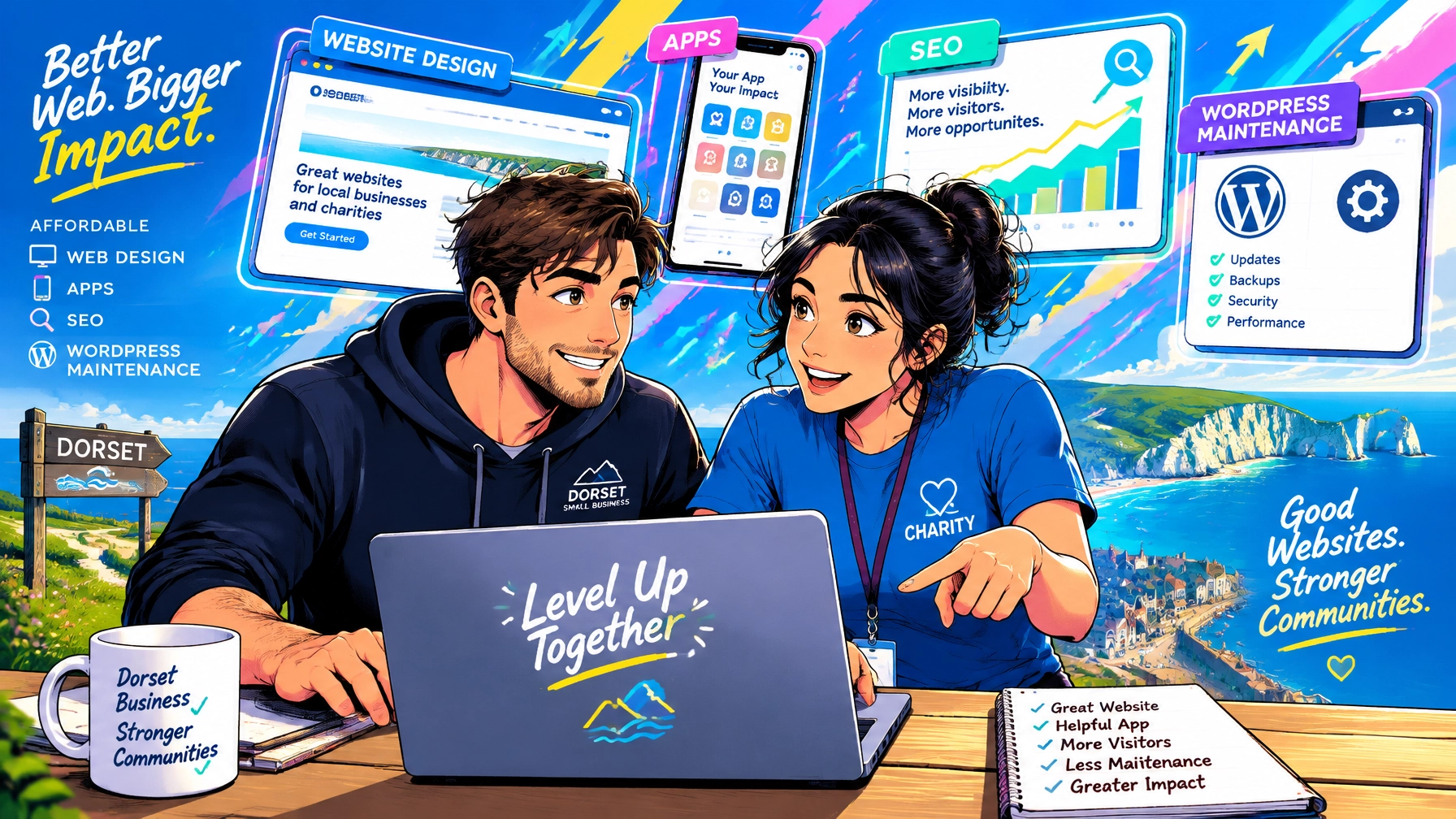
You don’t need to invest in every digital service at once to make progress. The best roadmap starts with what your business or charity needs to achieve, then prioritises the work that will help people find you, use your services and take the next step.
Whether you’re planning a new website, considering an app, improving search visibility or trying to keep WordPress running smoothly, a phased approach can help you make the most of your budget. Here’s how to decide what comes first, and what can wait.
Before choosing technology, write down two or three goals for the next 6–12 months. Make them specific enough to measure, such as:
Then identify who needs to use your digital services. A charity may need to support service users, volunteers, donors and trustees, while a local business might be focused on customers, staff and suppliers. Ask what each group needs to do, where they currently get stuck and what would make the experience clearer.
Next, review what you already have. Check your website on a phone, test important forms and links, look at available analytics and search data, and note any outdated content. You may be able to improve a sound website without paying for a complete rebuild.
Your website is often the most useful place to start because it can explain what you do, build confidence and help people act, without requiring them to install anything.
Optimise the pages visitors rely on most: your homepage, services or programmes, contact details, donation or booking journey, and key frequently asked questions. Make the next step obvious, use plain language, and check that the site is easy to navigate on mobile.
Review accessibility as part of that work, not as an afterthought. Check contrast, headings, keyboard navigation, form labels, link wording and image descriptions. For a charity, consider whether people with different access needs can find information and complete essential tasks. The Charity Digital Code of Practice treats accessibility as an ongoing part of digital practice; a focused review can help you identify where to begin.

If your website is outdated, difficult to use or hard to update, a rebuild may be worthwhile. Keep the brief grounded in real needs: agree which pages and features are essential, what content must be migrated, and what your team should be able to manage after launch.
For examples of different types of projects, explore Dorset Tech’s website portfolio.
WordPress can be a practical choice when your team needs to update pages, news, events, services or campaign content without asking a developer every time. It can suit many small and medium-sized organisations, but it isn’t automatically the best answer for every project.
Before choosing it, consider how often you’ll update the site, who will maintain it, and whether you need specialist functionality or integrations. Ask a supplier to explain the proposed setup, training, handover and any ongoing costs. Keep the plugin list purposeful and make sure your organisation retains access to its domain, website files and key accounts.
If WordPress is the right fit, Dorset Tech offers WordPress development. If you’re comparing options, NCVO’s guide to building a website or working with a specialist offers useful questions to consider.
SEO is a long-term way to help the right people discover your website through search. It works best when you’re already offering clear, useful pages, not as a substitute for fixing a confusing site or an incomplete customer journey.
Start with the basics. Check that important pages can be found and indexed, write descriptive page titles and headings, use clear URLs, add relevant internal links, and make sure your location and contact details are consistent. A Dorset business or charity should create local pages when they genuinely help people understand where and how a service is available, rather than publishing near-identical pages just to include place names.
Write content that answers real questions. That might include service information, event details, case studies, practical advice or explanations of how to access support. Use Google’s SEO Starter Guide to understand the foundations, and explore Dorset Tech’s SEO service.
Measure actions that matter to you, such as enquiries, sales, donations, bookings or volunteer applications. Search positions can be useful context, but they don’t tell you on their own whether people are finding what they need.
An app can be valuable when people return regularly and need a mobile experience that a responsive website can’t provide as simply. Examples might include a directory with useful filters, member tools, frequent bookings, notifications or a repeated workflow for staff in the field.
Before commissioning an app, speak with the people who would use it. Ask how often they’d use it, what they currently find difficult and whether a mobile website could do the job. A simple prototype or small pilot can help you test an idea before committing to a larger build.
Remember to budget for the app’s life after launch: updates, security, support, operating-system changes and any third-party services. The Club Hub project is an example of an app designed to help families search for activities by location, age, interest, day and cost. It illustrates a specific use case, not a reason every organisation needs an app.

For more detail on the possibilities, see Dorset Tech’s app development service.
A new website still needs care. Without regular attention, updates can be missed, backups may be out of date and forms or integrations can stop working without anyone noticing.
Plan who will look after the site and what support they need. A maintenance checklist could include:
The official WordPress backup guidance is a helpful starting point. Dorset Tech offers WordPress support and maintenance, with options to discuss around the way your organisation prefers to manage work.
For a charity, digital decisions affect more than fundraising. Your website may be an important route to services, information, referrals, volunteering and community engagement. Include the people who rely on those services when deciding what to improve, and consider keeping phone, email or in-person routes available where appropriate.
Build accessibility, privacy and safeguarding into the brief from the start. If you collect personal information, be clear about what you need and how it will be used. If funding is limited, prioritise the journey that matters most to your beneficiaries or supporters, then plan improvements in manageable stages.
Ask suppliers to separate essential work from optional enhancements and to itemise costs, including any hosting, domain, software or third-party charges. Dorset Tech has flexible, affordable solutions for different budgets, including options for charities and social enterprises. You can find out more about discounted rates.
Use this order as a starting point, not a rigid formula:
You can adjust the order to fit your situation. If your site is compromised, security comes first; if people can’t complete a donation or service journey, make that the priority.
Digital work isn’t finished when a new website goes live. Review your goals, feedback and results regularly, then decide what to improve next. Small, informed changes can help you keep pace with your audience without trying to build everything at once.
At Dorset Tech, we offer flexible solutions for different budgets, with no monthly agency fees and itemised, transparent billing. Our team brings an average of 19 years’ experience, and our carbon-negative commitment is part of how we aim to make a positive impact alongside our digital work.
Still unsure what should come first? Talk to Dorset Tech about your goals and budget, or explore our instant quote calculator.